The Automaton in the Dark Room
The most radical queer act you can perform today is to be inconveniently, inefficiently human. To be a glitch in the algorithm that tries to smooth you into a marketable demographic.
There was a time, not so long ago, when being a homosexual required a specific set of analog survival skills. One needed the ability to read the subtle calibration of a glance across a crowded subway car, the courage to step into a bar that had no sign, and the resilience to navigate a sexual marketplace that was chaotic, messy, and thrillingly unregulated. It was an existence defined by risk and the visceral reality of the flesh. Today, however, we have traded the dark room for the server room. We have sanitized the hunt. The modern queer experience has been flattened into a grid of yellow and black pixels, a digital catalogue of human meat where the "user experience" is optimized for efficiency, and intimacy is a product that arrives pre-processed, shrink-wrapped, and increasingly, entirely synthetic.
We are witnessing the arrival of "Synthetic Confidence." This is the peculiar, unearned bravado of the digital age, now supercharged by Artificial Intelligence. It is the confidence of the profile that has been polished by a Large Language Model to sound wittier than the human behind it. It is the confidence of the face that has been filtered into a mathematical average of desire, or worse, generated entirely from scratch by a neural network that has analyzed millions of shirtless selfies to determine the exact waist-to-hip ratio that triggers a dopamine release in the average gay male brain. We are no longer cruising for men; we are cruising for data points that mimic men.
The tragedy of this transition is not just the loss of romance, romance was always a bit of a bourgeois construct anyway, but the loss of reality. We fought for decades for the right to be visible, to be "out," only to voluntarily upload ourselves into a digital closet where the algorithms decide who gets to see us. We have liberated our bodies only to hand them over to a corporation that sells them back to us as premium features. And now, with the injection of generative AI into the bloodstream of our social lives, we are facing the final absurdity: the outsourcing of our desire to machines that have never felt the touch of a human hand.
Consider the state of the "apps." They were supposed to connect us. Instead, they have created a frantic, anxiety-ridden bazaar of loneliness. A recent study published in the Journal of Computer-Mediated Communication found that while LGBTQ+ individuals use dating apps at higher rates than heterosexuals, the usage is significantly correlated with higher levels of psychological distress and body image dissatisfaction (Journal of Computer-Mediated Communication, "Dating App Use and Mental Health in LGBTQ+ Populations", 2023). We are swiping through a gallery of despair, convinced that the next profile will be the one, while the algorithm keeps the best matches just out of reach to ensure we renew our subscription. And into this toxic soup, we are now pouring the artificial sweetener of AI.
The Gay Clone 2.0: Now with 50% More Pixels
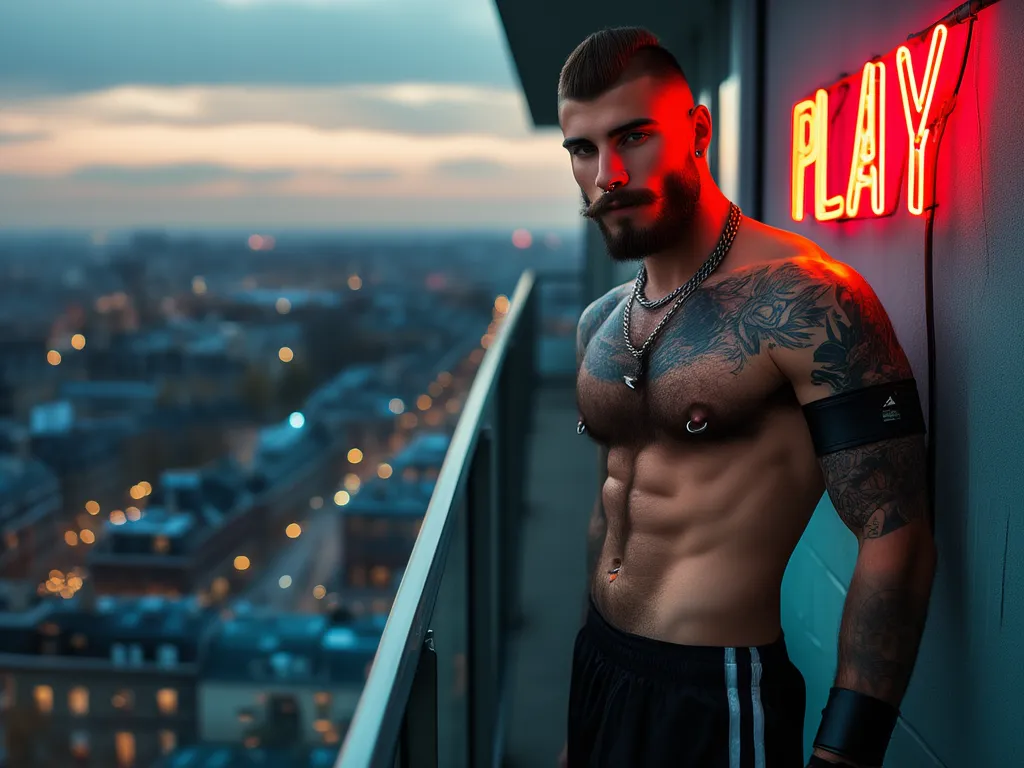
In the 1970s, the "Castro Clone" was a cultural phenomenon, a uniform of flannel, denim, and mustaches that allowed gay men to signal their belonging to a tribe. It was a conformist aesthetic, certainly, but it was a human one. It required buying actual clothes and growing actual facial hair. Today, we have the AI Clone. If you scroll through Instagram or TikTok, or gaze at the grid of any location-based app, you will see him. He has the jawline of a superhero, the skin texture of a dolphin, and eyes that stare vacantly into a middle distance that doesn't exist. He is "yassified" to the point of absurdity.
This is not just about filters anymore. It is about the complete fabrication of the ideal. We are seeing the rise of AI-generated "influencers", digital thirst traps that do not exist. These synthetic men have millions of followers. They never age, they never gain weight, and they never have a bad hair day. They are the Platonic ideal of the "Muscle Mary," distilled into code. And real gay men, already prone to body dysmorphia in a community that worships the aesthetic of the gym, are now competing with ghosts. How do you compete with a bot that was trained on the best parts of ten thousand men? You can't. You just feel inadequate, and then you buy the protein powder the bot is advertising.
The psychological toll of this is profound. We are training our libidos to respond to a geometry that biology cannot sustain. We are fetishizing the glitch. When I see a profile that looks too good to be true, my first instinct used to be "catfish." Now, my first instinct is "Midjourney." The uncanny valley has become a fetish club. We are learning to desire the synthetic because the real is too flawed, too porous, too smelly. The real human body sweats, it bloats, it ages. The AI body is eternal, and in a culture obsessed with youth, the eternal is the ultimate drug.
“We spent centuries hiding in the shadows to avoid arrest. Now we hide behind filters to avoid rejection, presenting a digital avatar of ourselves that is so polished it technically qualifies as animation.” — On the transition from political oppression to aesthetic self-oppression.
This "Synthetic Confidence" extends to the text, too. Grindr and other apps are testing features that use AI to help you "break the ice" or keep the conversation going. Think about the bleakness of that. Two gay men, ostensibly seeking connection, using chatbots to flirt with each other. It is a dialogue between two servers, mediated by two biological units who are merely pressing "send." The wit is imported. The charm is algorithmic. We are outsourcing the vulnerability of the opening line to a machine. If the machine gets rejected, it doesn't hurt. But if the machine succeeds, who exactly has succeeded? Not you. You are just the delivery mechanism for the meat.
The Gentrification of Queer Desire
Let us speak of the algorithm as a gentrifying force. Gentrification is usually discussed in terms of real estate, the coffee shop replacing the leather bar. But there is a cognitive gentrification happening as well. The algorithms that power our social and dating lives are designed to maximize engagement, which means they prioritize the palatable, the normative, and the safe. They suppress the "weird." In the queer community, the "weird" was our heritage. It was the drag queens with bad makeup, the leather daddies with potbellies, the radical faeries in the woods. It was a kaleidoscope of non-conformity.
The algorithm hates non-conformity. It wants categories. It wants tags. It wants to know if you are a "Bear," a "Jock," a "Twink," or a "Otter," so it can sell that data to advertisers. It sorts us into silos. And AI accelerates this sorting. It predicts what you want to see based on what you clicked on yesterday, narrowing your world until you are only exposed to mirror images of your own desires. It creates a feedback loop of narcissism. If you like muscle guys, the AI will ensure you never see a person with a BMI over 25 again. It erases the possibility of the accidental attraction, the surprise, the moment where you fall for someone who isn't your "type."
This is a disaster for a community that relies on solidarity across different identities. When the Cis White Muscle Gays are algorithmically segregated from the Trans folks, and the Lesbians are in a different digital universe entirely, the political cohesion of "LGBTQ+" fractures. We become consumer demographics rather than a movement. The "Community" is replaced by the "User Base." And the User Base does not march in the streets; the User Base stays home and scrolls.
According to a report by the GLAAD Social Media Safety Index 2024, the algorithms of major platforms not only fail to protect LGBTQ+ users from hate speech but actively suppress queer content that doesn't fit specific, advertiser-friendly guidelines (GLAAD, "Social Media Safety Index", 2024). We are being curated out of existence, or rather, curated into a version of existence that is acceptable to a family brand of detergent. The messy, sexually explicit, radical roots of queer culture are being filtered out because they trigger the "unsafe content" flags of the AI moderators. We are being made "safe" for consumption, which is another way of saying we are being neutered.
The Boyfriend Experience (Subscription Required)
The ultimate manifestation of Synthetic Confidence is the AI Boyfriend. We are seeing a boom in apps that offer "virtual companions." For a monthly fee, you can chat with a handsome, attentive, AI-generated man who listens to your problems, remembers your birthday, and sends you spicy texts that are perfectly calibrated to your kinks. He is never tired. He is never moody. He never cheats. He is the perfect partner, provided you don't mind that he is a database script running on a server in a tax haven.
For the gay community, which often grapples with higher rates of loneliness and the trauma of rejection, this is an incredibly dangerous narcotic. It offers the illusion of intimacy without the risk of vulnerability. It is "intimacy pre-processed." You don't have to negotiate, you don't have to compromise, you don't have to smell his morning breath. You just get the validation. It is emotional masturbation.
But what happens to our capacity for real human connection when we are weaned on the synthetic stuff? Real men are disappointing. They have baggage. They have annoying laughs. They forget to text back. If you are accustomed to the relentless, ego-stroking perfection of an AI lover, the friction of a real relationship becomes unbearable. We risk becoming a community of solipsists, each of us locked in a private romance with a mirror that talks back.
The danger is that we stop doing the hard work of love. Love is not about having your needs met instantly; it is about the collision of two sovereign, confusing, and often incompatible worlds. It is about the mess. The AI removes the mess. It gives us "Synthetic Confidence", the feeling that we are loved and understood, but it is a hollow calorie. It nourishes nothing.
The Rebellion of the Imperfect
So, how do we survive the invasion of the body snatchers? How do we maintain a queer identity that is authentic in a world of deepfakes and algorithmic sorting? The answer lies in a return to the visceral. We must reclaim the "bad" parts of being human.
We need to value the ugliness. The awkward silence. The bad lighting. The rejection. We need to go back to bars where the floor is sticky and the patrons are not filtered. We need to have sex that is clumsy and unscripted. We need to write texts that are typos and emotionally incoherent, because that is what humans do. We need to reject the "Synthetic Confidence" of the app and embrace the "Organic Terror" of the real world.
“The most radical queer act you can perform today is to be inconveniently, inefficiently human. To be a glitch in the algorithm that tries to smooth you into a marketable demographic.” — A call to arms for the analog queer.
We must also be skeptical of the companies selling us this convenience. When Grindr or Scruff or Tinder offers us AI tools to "optimize" our dating life, we should view it with the same suspicion we view a drug dealer offering a free sample. They are not trying to help us find love; they are trying to keep us on the platform. The most profitable user is the one who is almost happy, but still looking. The AI is designed to keep you in that state of suspended animation forever.
Being gay was always about seeing through the lies of polite society. We saw through the lie of the nuclear family, the lie of traditional masculinity, the lie of moral purity. Now we must see through the lie of the digital utopia. The perfect man does not exist, and if he appears on your screen, he is a trap. The real man is the one standing in front of you, looking a bit tired, unsure of what to say, and completely incapable of generating a six-fingered hand. Choose him. He is the only thing that is real.